Securing Our Future with
Emergency Services.
Learn how the proposed Hunt County Emergency Services District No. 2 will provide dedicated funding to drastically improve emergency response, protect property, and save lives in our community.
What is an ESD?
An Emergency Services District (ESD) is a grassroots, local government entity created by voters to provide stable, dedicated funding for fire protection, emergency medical response, or both.
Unlike volunteer fire departments that rely heavily on unpredictable donations and fundraisers, an ESD guarantees a reliable budget. This means our local fire stations can afford the modern equipment, training, and personnel required to keep our growing community safe.
- Created by local voters, for local residents
- Funds stay 100% within the district boundaries
- Governed by an appointed board of local citizens
- Ensures reliable and rapid emergency response
Local Control
An ESD ensures that our tax dollars are managed locally, specifically to fund the emergency services that protect our own homes and families.
Community Benefits
Faster Response
Dedicated funding allows for better staffing and strategically placed equipment, drastically reducing the time it takes for help to arrive during an emergency.
Better Equipment
Replaces outdated, unsafe fire trucks and medical gear with modern, reliable equipment that our first responders need to do their jobs effectively.
Lower Insurance
Improved fire department ratings (ISO scores) due to better equipment and water access often lead to significantly lower homeowner insurance premiums.
A Smart Investment
Public safety isn't an expense; it's an investment. Establishing an ESD is one of the most cost-effective ways to protect the value of your property and the lives of your loved ones.
The minimal tax collected ensures that when you call 911, an equipped and trained professional will respond immediately. Furthermore, the savings you may see on your property insurance could offset the cost of the ESD tax altogether.
Predictable Funding
Moves first responders away from relying on bake sales and donations toward a stable, strategic annual budget.
Future-Proofing
As Hunt County grows, the ESD scales its services automatically to meet the rising demand for emergencies.
5 Year Road Map
A phased, fiscally responsible path from formation to a fully modernized emergency response system.
Foundation
- Collect signatures on the ESD petition
- County holds a public hearing
- County Commissioners approve the ESD to go to ballot and citizens vote
- ESD Board is appointed
- Full equipment and department audit, budgets presented, and the tax rate is set
Year 1
- First tax is collected
- Top priority: replace breathing apparatus and firefighting gear to bring it into standard — the life-safety emergency
- Stipend volunteers to encourage retention
- Establish training and staffing standards for the volunteer force
Capital Build
- Finance the first new replacement pumper
- Upgrade stations to allow for staffing
- Launch a formal training program for certification and operational standards
- Bring departments within Texas Commission on Fire Protection standards
- Request an ISO study to identify where improvement is needed so ISO/PPC scores can be lowered district-wide
First Paid Staff
- Begin hiring professional paid firefighters to supplement volunteers
- Push the ISO rating from 9–10 toward Class 6 throughout the district
Full Service
- Expand 24/7 professional paid staffing
- Target ISO Class 4–5
- Board evaluates a rate reduction at this phase
Texas ESD Success Stories
When communities across Texas choose to establish Emergency Services Districts, the results are overwhelmingly positive. Here are just a few examples of how ESDs have transformed local safety.
Drastically Cut Response Times
With dedicated funding from an ESD, communities like Spicewood (ESD No. 9) opened new stations and cut average response times from 25 minutes down to just 9 minutes.
Elite Fire Protection Ratings
By investing in better water supply operations and equipment, ESDs like Bexar County ESD No. 2 achieved an ISO Class 1 rating—a distinction held by less than 1% of departments nationwide, leading to lower property insurance premiums.
Solving Staffing Shortages
Instead of relying on overwhelmed volunteers, ESDs like Harris County ESD 11 provide competitive pay and modern equipment, permanently solving dangerous staffing shortages to ensure rapid response 24/7/365.
Proposed Coverage Area
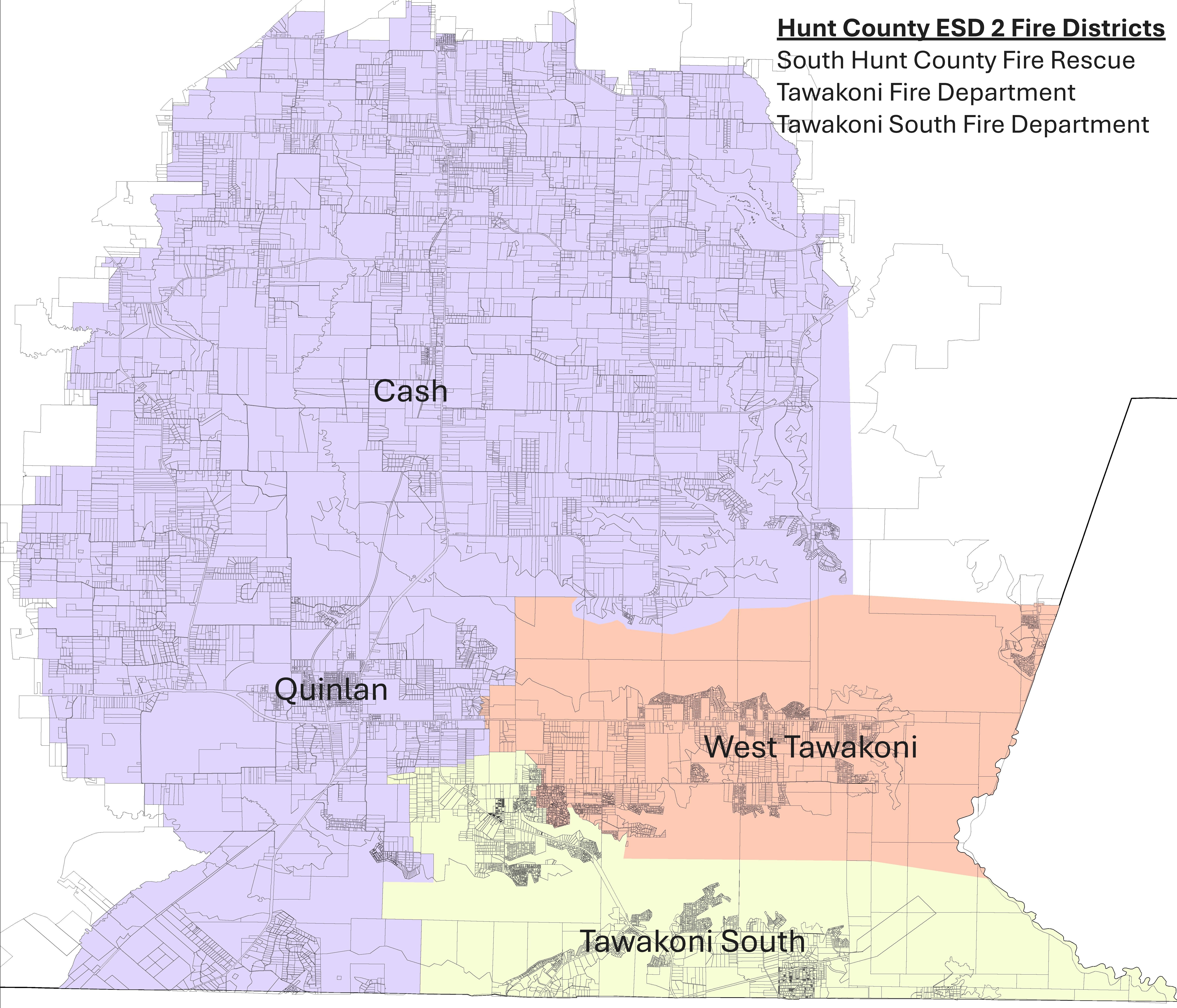
The proposed Hunt County ESD 2 would serve the South Hunt County, Tawakoni South, and West Tawakoni Fire Districts, ensuring these vital regions have the emergency support they deserve.
July 7th 2026 Public Hearing
Watch the recording of the July 7th 2026 public hearing regarding the proposed Hunt County Emergency Services District No. 2.
Voter FAQ
Answers to commonly asked questions about Emergency Services Districts. Information referenced from the SAFE-D website.
Depending on the ESD’s creation documents, an ESD can provide fire protection, emergency medical services or both.
ESDs are allowed to levy ad valorem (property) tax. The Texas Constitution states that ESDs may tax up to $0.10 per $100 of property valuation. The ESD’s creation documents establish the district’s initial tax rate. They may also collect sales tax with voter approval, and bill for services provided.
A board of five commissioners governs ESDs. In most counties in Texas, the County Commissioners Court appoints the commissioners to two-year terms. They are an independent governmental entity, not an extension of the county's government.
Unless the ESD falls under an exception, ESDs are required by law to file an audit with their County Commissioners Court by June 1 of each year. They must also meet at least once a month in open meetings subject to the Texas Open Meetings Act.
Community Questions and Comments
Questions raised by residents during public discussion, answered directly.
Yes, the ESD funds and contracts; the departments keep their 501(c)(3) status and identity.
They stay with the departments that own them. The ESD doesn't seize anything. Terms are spelled out in the agreement before anything is signed.
The voters set the ceiling, the amount the tax rate cannot exceed, when they vote on the ballot at ten cents; the board sets the real, possibly lower, working rate after formation once a review of needs, equipment, audit and assessment of departments and budgets have been discussed.
The Commissioners Court appoints five ESD Board Commissioners, to serve in staggered terms. The way in which they are selected lies with the Hunt County Commissioners Court with public input.
Yes, it is legally required. Every meeting is public with public comment and input.
Members can join the new provider department; owned equipment stays with the agency that owns that equipment.
Because it costs more, it's less fair, and it competes with everything else for the same dollar. A county fire department comes out of the county general fund, which means it raises the tax rate for everyone in the county, including Greenville and Commerce residents who already have their own fire protection. They'd pay again for a service they don't receive. That's not fair.
County money is never protected. It fights roads, law enforcement, courts, and health every single budget cycle, and it can be cut anytime. ESD revenue is constitutionally locked to fire and rescue; it can't be raided.
It is entirely plausible the county could aggressively increase taxes to pay for better fire services, but doing so would wreck the county's ability to keep up appropriate funding levels for other essential services. Additionally, though the county is limited on how much it can increase taxes each year, it is not capped on the tax rate it can impose, so theoretically it can max out your increase year after year. ESDs, though, are capped at $0.10 per $100 of valuation. So if you want to ensure a tax cap for your fire service, an ESD is your answer.
ESDs also put in an additional layer of oversight. They are dedicated to solely overseeing the ESD and, in turn, are overseen by the Commissioners Court. Without the ESD, you don't have a constitutionally dedicated board to oversee the fire service in their area, and instead have the Commissioners Court providing oversight along with overseeing the entire rest of the county government.